





Overview
Are you a student developer ready to create a difference?
Join the Solution Challenge 2026 India and build solutions that solve real-world problems. It’s your chance to use Google developer technologies to design, prototype, and launch ideas that create measurable impact for communities around us.
Let’s build the future with AI.
Register now Team: 1–4 members
 Age 18+ only
 India
India
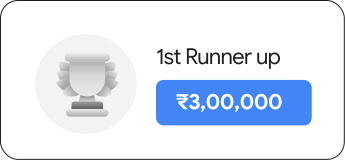
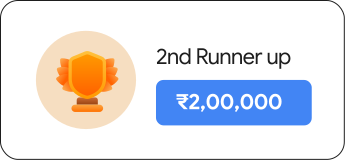
Congratulations to the Winners


Maharashtra Institute of Technology, Aurangabad


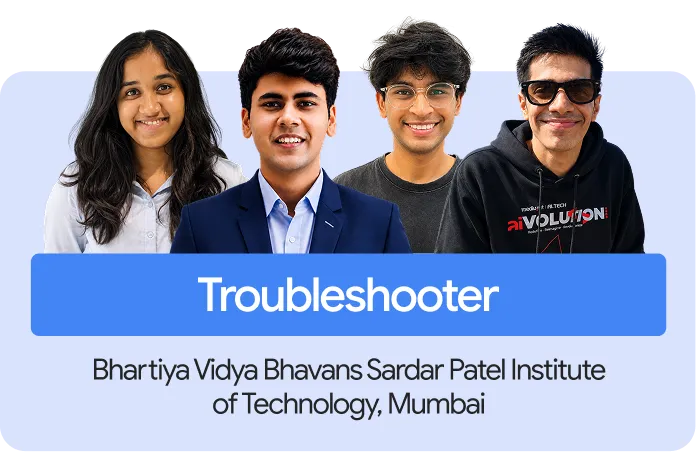
Bhartiya Vidya Bhavans Sardar Patel Institute of Technology, Mumbai


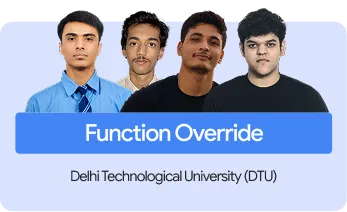
Delhi Technological University (DTU)


Institute of Engineering & Management, Kolkata

Maharishi Markandeshwar Engineering College, Haryana
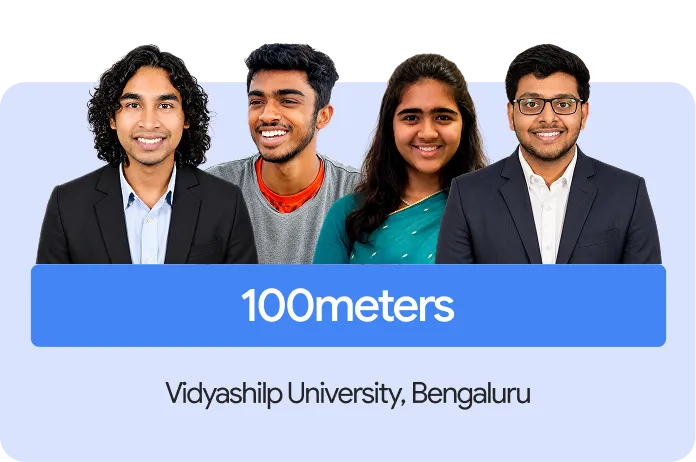
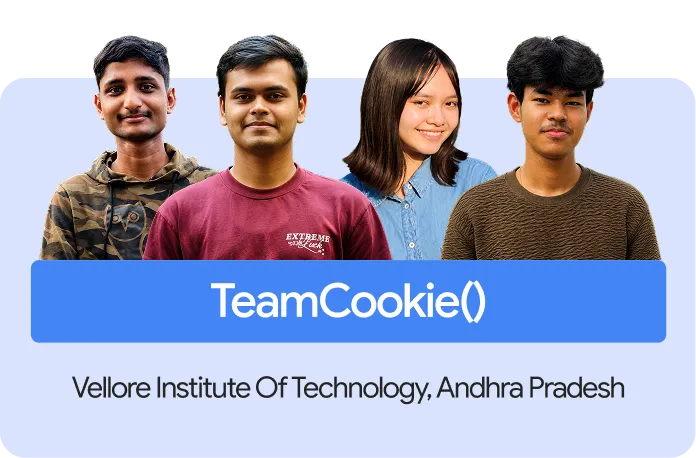
Congratulations to our top 14 teams




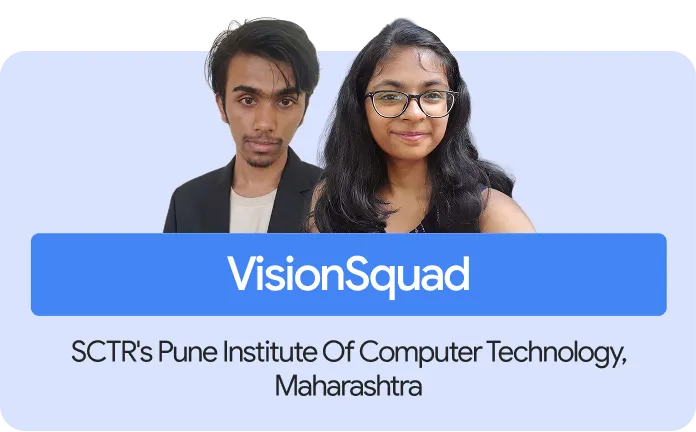
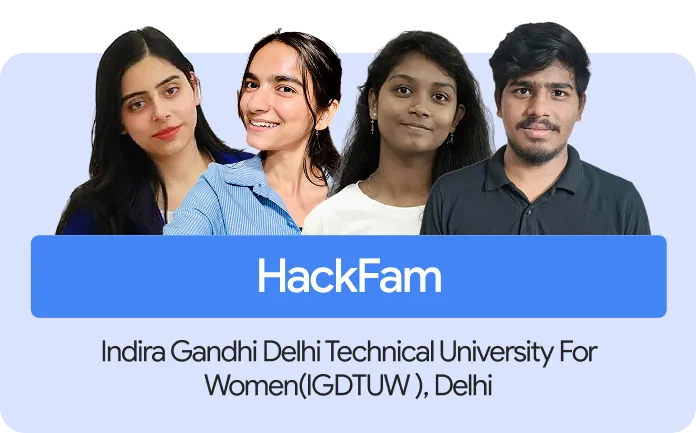
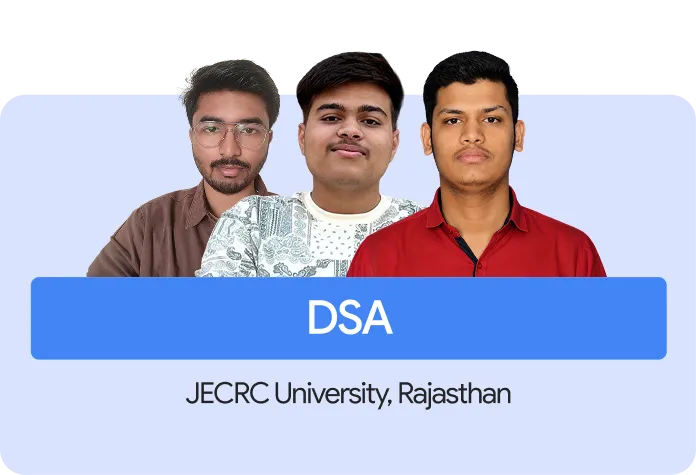
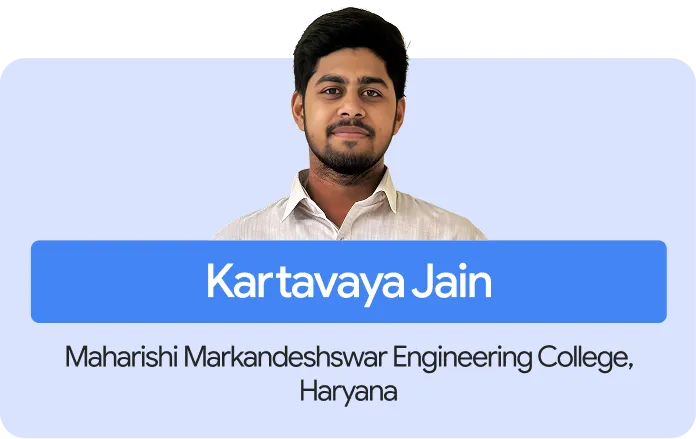



What Makes This Hackathon Different?
01.
Build with Purpose
Work on real challenges that actually make an impact in the real world.
02.
Leverage Google Technologies
Use Flutter, Firebase, Google Cloud, AI/ML APIs, and more to turn your ideas into reality.
03.
Collaborate & Compete
Team up, refine your solution, and pitch it in front of the jury.
04.
Mentorship & Recognition
Get guidance from industry experts and earn the chance to showcase your innovation on a national stage.
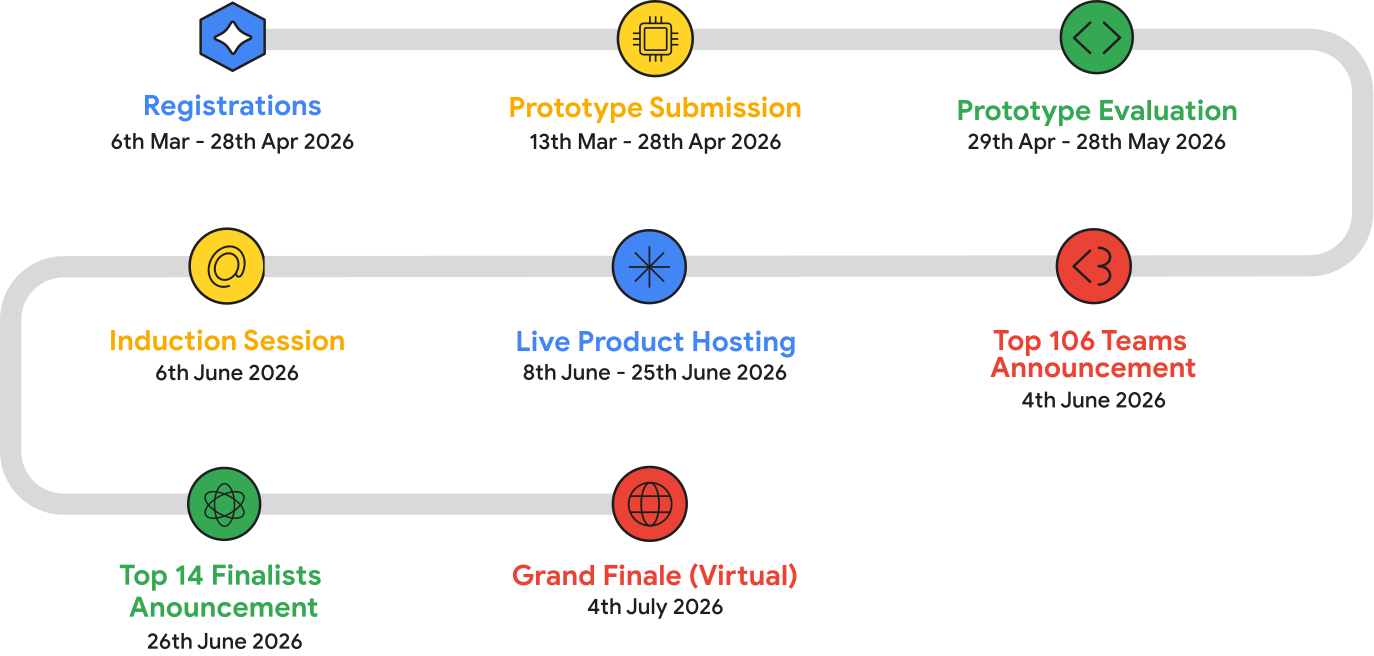
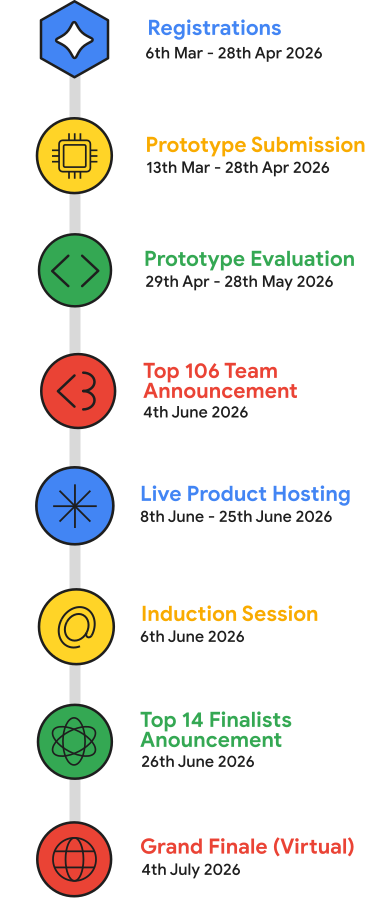
Roadmap
Eligibility

The participants must be 18 years or older to be eligible.

Participants must be enrolled in a university/college of India

Participants must form a team of 1–4 members

One participant join only one team

One team has to submit one project
The participants must be 18 years or older to be eligible.
Participants must be enrolled in a university/college of India
Participants must form a team of 1–4 members
One participant join only one team
One team has to submit one project


Problem Statement and Challenges
Digital Asset Protection
Protecting the Integrity of Digital Sports Media
Sports organizations generate massive volumes of high-value digital media that rapidly scatter across global platforms, making it nearly impossible to track. This vast visibility gap leaves proprietary content highly vulnerable to widespread digital misappropriation, unauthorized redistribution, and intellectual property violations.
Objective
Develop a scalable, innovative solution to identify, track, and flag unauthorized use or misappropriation of official sports media across the internet. Enable organizations to proactively authenticate their digital assets and detect anomalies in content propagation in near real-time.
Rapid Crisis Response
Accelerated Emergency Response and Crisis Coordination in Hospitality
Hospitality venues face unpredictable, high-stakes emergencies that demand instantaneous, coordinated reactions to protect lives and property. During a crisis, critical information is often siloed, fracturing communication between distressed guests, on-site staff, and first responders.
Objective
Design a robust solution to instantly detect, report, and synchronize crisis response efforts across a decentralized hospitality ecosystem. Eliminate fragmented communication by creating a highly reliable bridge between distressed individuals, active personnel, and emergency services.
Smart Supply Chains
Resilient Logistics and Dynamic Supply Chain Optimization
Modern global supply chains manage millions of concurrent shipments across highly complex and inherently volatile transportation networks. Critical transit disruptions ranging from sudden weather events to hidden operational bottlenecks are chronically identified only after delivery timelines are already compromised.
Objective
Design a scalable system capable of continuously analyzing multifaceted transit data to preemptively detect and flag potential supply chain disruptions. Formulate dynamic mechanisms that instantly execute or recommend highly optimized route adjustments before localized bottlenecks cascade into broader delays.
Unbiased AI Decision
Ensuring Fairness and Detecting Bias in Automated Decisions
Computer programs now make life-changing decisions about who gets a job, a bank loan, or even medical care. However, if these programs learn from flawed or unfair historical data, they will repeat and amplify those exact same discriminatory mistakes.
Objective
Build a clear, accessible solution to thoroughly inspect data sets and software models for hidden unfairness or discrimination. Provide organizations with an easy way to measure, flag, and fix harmful bias before their systems impact real people.
Smart Resource Allocation
Data-Driven Volunteer Coordination for Social Impact
Local social groups and NGOs collect a lot of important information about community needs through paper surveys and field reports. However, this valuable data is often scattered across different places, making it hard to see the biggest problems clearly.
Objective
Design a powerful system that gathers scattered community information to clearly show the most urgent local needs. Build a smart way to quickly match and connect available volunteers with the specific tasks and areas where they are needed most.
Open Innovation:
For every theme, you can also choose the Open Innovation track. This allows you to explore your own approach while staying within the theme, addressing the challenge you're passionate about. Build your solution as an open innovation project under the theme and make your ideas count.


What to Build
Project Submission
Requirements
Submit your initial working prototype during registration. Each submission must include:
- Problem Statement: Clearly define the issue your team is addressing.
- Solution Overview: Explain how your prototype solves the problem.
- Prototype Link: A live MVP link demonstrating core functionality.
- Project Deck: Concise deck detailing your solution and impact.
- GitHub Repository: Public link to the source code.
- Demo Video: A short video showcasing your solution and its functionality.
Refined Prototype Submission Shortlisted teams must enhance their solutions and submit:
- Updated prototype link demonstrating improvements
- Refined project deck highlighting technical enhancements, scalability, usability, and impact
- Updated demo video showcasing the evolved solution
- Brief note outlining key refinements made
- Updated GitHub repository reflecting improvements
Product Vault Access- Selected teams receive:
- Structured mentorship and technical guidance
- Sandbox access and ecosystem support
- Access to Google Cloud credits, APIs, and advanced tools.
- Support to improve performance, security, scalability, and production readiness
Finalists submit their polished solution for evaluation and pitching:
- Final Prototype Link: Fully functional solution ready for demo.
- Final Project Deck: Comprehensive overview including goals, features, technical implementation, and real-world impact.
- Final Demo Video: Showcase the refined prototype in action (up to 3 minutes).
Evaluation Criteria
For Prototype Submission
Hackathon Journey
Registration and Prototype Submission

Individual Registration : Each participant must register individually on the official platform.

Team Formation : Create or join a team of 1–4 members during the registration period.

Prototype Submission : Each team must submit one working prototype that includes:
Problem Statement: Clearly define or select the issue you are addressing.
Solution Brief: Explain how your prototype solves the identified problem.
Prototype Link: A live MVP link demonstrating core functionality.
Project Deck: Demo Video: A short video (as per official guidelines) showcasing your solution and its functionality.
GitHub Repository: Public link to the complete source code.

Demo Video: A short video showcasing your solution.
Top 106 Teams & Product Vault

Shortlisting : The top 106 teams will be selected based on innovation, feasibility, impact, and technical implementation.

Product Vault Access : Selected teams will advance to the Product Vault stage and receive structured support to refine, test, and scale their solutions.

Access to Resources & Mentorship : Teams will gain curated learning resources, technical guidance, ecosystem support, and mentorship from industry experts and technical leaders.

Refined Prototype Submission :
Shortlisted teams must submit an improved
version of their prototype incorporating
feedback and enhancements.
The submission should include:
Updated prototype link (stable and accessible)
Brief refinements made from previous submissions
Refined project deck (if applicable)
Demonstrated improvements in performance, scalability, usability, security, and technical depth

Refined Prototype Evaluation : Submissions will be evaluated for scalability, user impact, execution clarity, and solution maturity & Production readiness.
Grand Finale (Virtual)

Finalists Announcement : Top 14 teams will be shortlisted as finalists.

Final Pitch Presentation : Finalists will present their refined solutions before a panel of judges.

Evaluation Criteria : Judging will be based on innovation, impact, technical depth, scalability, and presentation quality.

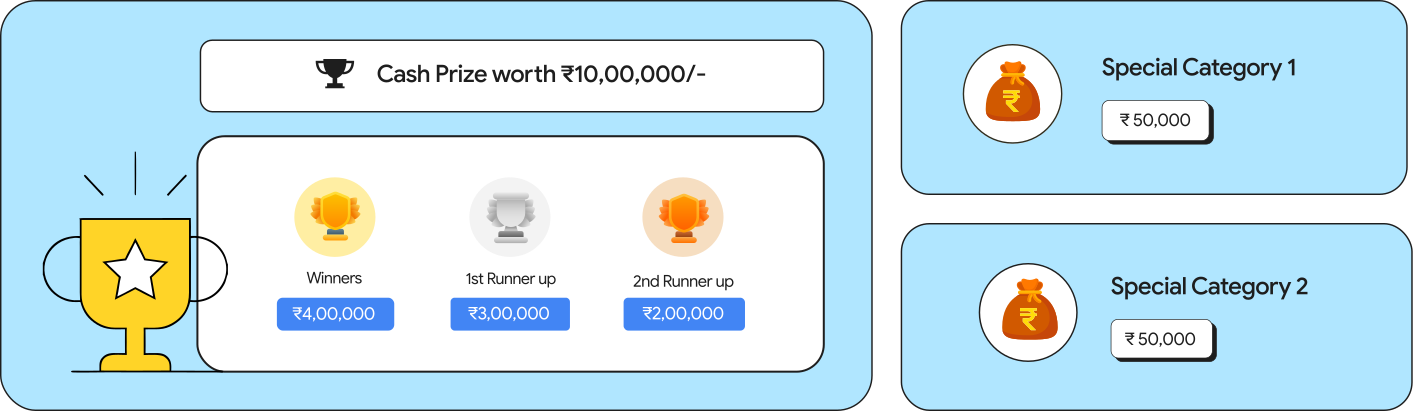
Awards & Recognition : Top teams will compete for prizes, recognition, and opportunities to further accelerate their solutions.